


Welcome to Movement Therapy Clinics
The pain that never fully went away
Recurrent back pain that flares every time you spend a day in the garden. A shoulder that’s been “manageable” for three years but stops you reaching the top shelf. A knee that grumbles on the stairs, then rules out Titterstone Clee and the Mortimer Forest trails altogether. You’ve had treatment. It helped, briefly. Nothing built underneath it.
Preparing for surgery — prehabilitation
A hip or knee replacement, a shoulder repair, a hernia repair. Going into an operation stronger changes what comes out the other side — shorter stays, faster mobilisation, better twelve-month outcomes. Prehabilitation is one of the most under-used interventions in musculoskeletal care, and the months on the waiting list are usually spent deconditioning rather than preparing.
Rehabilitation after an operation
Therapy got you through the early protocol and then stopped. But “no longer injured” and “back to full function” are a long way apart — and full function might mean carrying shopping up from the market square, getting a grandchild onto your shoulders, managing a full day at the allotment, or riding the Long Mynd again without dreading the descent. Closing that gap takes months of progressive loading, not a discharge letter.
Old Street, Ludlow · By appointment
MovementTherapy Ludlow
Strength as clinical care — specialist musculoskeletal rehabilitation in Ludlow, Shropshire
Most musculoskeletal problems don’t resolve because nobody ever built the capacity back. You were told to rest. You were given a sheet of exercises for a fortnight. You were discharged when the pain settled — but not when the tissue, the strength, or the confidence had actually returned.
This is a clinic for the work that comes after that.
I’m Mike Grice — clinical anatomist, musculoskeletal educator, and Education Director at Movement Therapy Education. I hold a Bachelor of Osteopathy and a postgraduate certificate in clinical anatomy, and I’ve spent twenty years teaching musculoskeletal assessment and rehabilitation to therapists. I was a university lecturer on the sports therapy programme at University College Birmingham from 2011 to 2018, where I was module leader for the strength and conditioning module. I’ve lectured at the IOC World Conference on Injury Prevention, host the annual Sports Therapy Association conference here in Ludlow, sit on the board of the Therapy Show in Birmingham, and am Clinic Director for the Academy of Shockwave Excellence in Atlanta, Georgia. In Ludlow, I work with a small number of people on long-term, individually structured strength and conditioning programmes.
Old Street, Ludlow. Places are limited.
Enquire about availability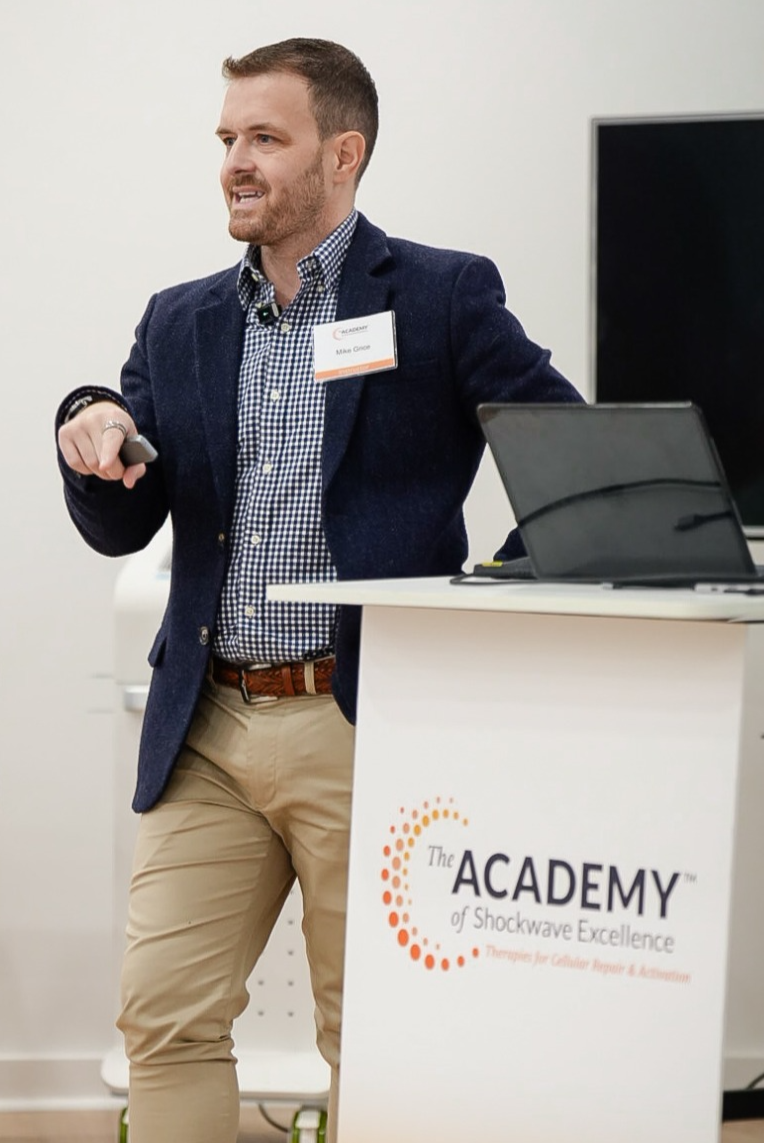



Mike is an International Lecturer and specialises in the teaching of Shockwave and musculoskeletal healthcare.


The evidence on musculoskeletal care is uncomfortable but clear. Manual therapy and generic exercise both have a role — and both have modest, short-lived effects when used alone. A recent editorial in the Journal of Manual & Manipulative Therapy (Lewis, Mintken & McDevitt, 2025) puts it plainly: the profession’s next step isn’t a better technique, it’s a wider scope. Sleep, activity, load, stress and behaviour shape outcomes far more than anything that happens in a treatment-room hour.
So the model here is different.
Why passive treatment stalls
If what you’ve had so far has been largely passive — massage, manipulation, acupuncture, ultrasound, injections — it’s worth being clear about what that does and doesn’t achieve. Passive treatment can be very effective at reducing pain in the short term. What it cannot do is make a tissue stronger. Nothing done to you builds capacity; only what you do yourself does that.
The simplest way to think about most persistent musculoskeletal problems is as a mismatch between load and capacity. Load is everything you ask the tissue to tolerate — the garden, the hill, the stairs, the working day. Capacity is what that tissue can currently handle. Symptoms appear when load exceeds capacity, and there are only two ways to close the gap: reduce the load, or raise the capacity.
Passive treatment, and rest, work on the first. They lower the symptoms and buy you a quieter few weeks. But capacity is unchanged — often lower, because rest deconditions — so as soon as you return to the garden or the hill, load exceeds capacity again and you’re back where you started. That’s the cycle most people are stuck in, sometimes for years.
Raising capacity is slower, and it’s the only durable answer. It means graded, progressive loading over months, taking the tissue’s tolerance up rather than taking your life down to meet it. That’s what this clinic does.
Some adjuncts genuinely earn their place alongside that work. Shockwave therapy is one — I teach it internationally and use it here — but never as a standalone treatment. The evidence supports it as a way of reducing symptoms enough for meaningful loading to begin, and it is prescribed alongside a loading programme, never instead of one. The same applies to hands-on work. The adjunct opens the door; the loading is what walks you through it.
Rio E, Kidgell D, Moseley GL, et al. Tendon neuroplastic training: changing the way we think about tendon rehabilitation. British Journal of Sports Medicine 2016;50:209–215.
What this is not
This is specialist musculoskeletal care delivered by someone who teaches the subject for a living. The exercise is the intervention — prescribed, progressed and monitored the way any other clinical intervention should be.
It’s not a fitness package. There’s no six-week transformation, no body composition goal, no generic programme with your name on it. If you want to look different, I’m not the right person. If you want to walk Mortimer Forest without stopping, lift your grandchildren, get a full season out of the garden, or get back to playing the sport you love — you're in the right place.
Practical details
Three months is enough to build a foundation and see genuine change. Six months takes you through a full progressive cycle. Twelve months is where training becomes part of your life.
Fees
Shockwave therapy
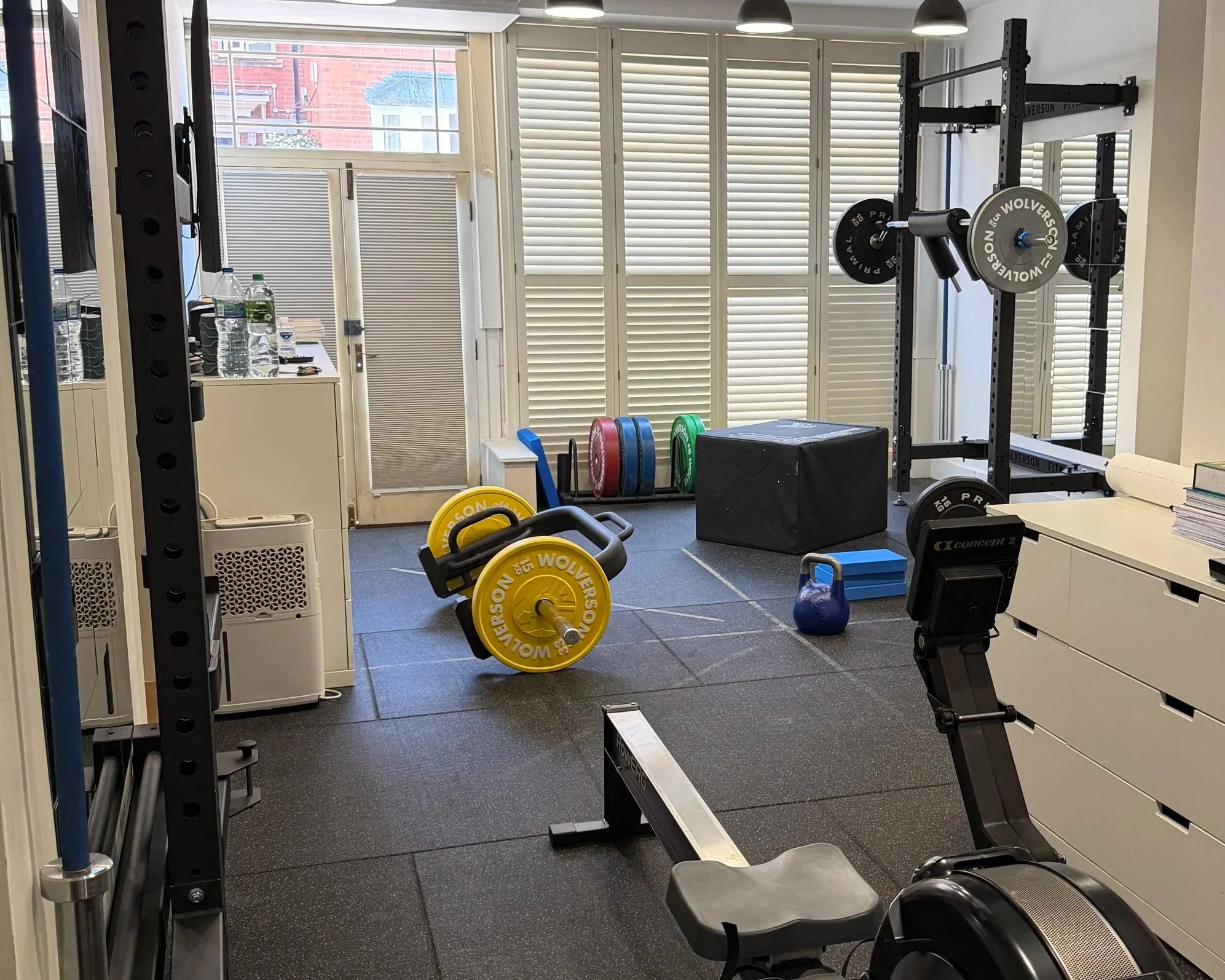
The clinic in Ludlow is a specialist shockwave and strength & conditioning clinic. The clinic has radial and focused shockwave, EMTT, as well as a fully functional weights gym. The combination of radial and focused shockwave is the gold-standard, non-invasive treatment for tendon, plantar fascia and myofascial pain issues.
Shockwave is sold in blocks of three or six sessions, paid upfront, and always prescribed alongside a loading programme. Choose shockwave alone if you already train and don’t need me to coach the strength work — or the combined option, where each visit also includes a strength training session for the area we’re treating.
| Option | 3 sessions | 6 sessions |
|---|---|---|
| Shockwave onlyfor people who already train independently | £360£120 per session | £660£110 per session · save £60 |
| Shockwave + strength trainingincludes a coached session for the affected area | £450£150 per session · worth £240 | £840£140 per session · save £60 |
Blocks are paid in full before the first session. Sessions are usually weekly.
Long-term strength & conditioning
Individually programmed, clinically led strength and conditioning in three, six or twelve month blocks. The standard individual session rate is £120; the longer you commit, and the more often you train, the lower your effective session rate. Payment is by monthly Direct Debit, and prices are based on 48 training weeks per year — four weeks of holiday are already built in.
| Commitment | Once a week | Twice a week |
|---|---|---|
| 3 months | £420 / month£105 per session | £760 / month£95 per session |
| 6 months | £400 / month£100 per session | £720 / month£90 per session |
| 12 monthsbest value · includes 4 weeks’ holiday | £360 / month£90 per session | £640 / month£80 per session |
Monthly figures assume four sessions per month (once a week) or eight (twice a week). Your initial assessment is included in your first month. Sessions run for as long as the work needs — you get what the session calls for, not a fixed slot.
Start the conversation
I take on a small number of people at a time, and places fill quickly. If something has been going on for years, or you have a date in the diary for an operation, the sooner we start the more there is to work with.
Get in touch and we’ll talk through where you are, what you want back, and whether a three, six or twelve month block is the right fit. No obligation to book anything from that conversation.
Enquire about availabilityMichael Grice B.Ost (Osteopathy), BA (Hons), Cert Ed, PGCert Clinical Anatomy
- Payment. Strength & conditioning programmes are paid by monthly Direct Debit, with the first payment taken at the start of the programme. Shockwave blocks are paid in full before the first session.
- Commitment. Programmes run for the full three, six or twelve month term you choose. The discounted rate reflects that commitment, so the Direct Debit runs for the whole term.
- Rearranging sessions. Life happens — I’m happy to rearrange a session where I can, with at least 24 hours’ notice. Rearranged sessions are subject to availability and should normally be taken within the same month. Sessions missed without notice are counted as delivered.
- Holiday. Twelve-month programmes include four weeks of holiday, already reflected in the monthly price — just let me know your dates in advance. Shorter blocks assume continuous attendance.
- Illness and injury. If you’re unwell, don’t train — tell me as early as you can and we’ll reschedule. If a medical issue means you genuinely can’t continue a programme, we’ll pause it rather than lose it.
- Shockwave block validity. Shockwave works best delivered consistently, so three-session blocks should be completed within eight weeks and six-session blocks within twelve. If continuing is no longer clinically appropriate, I’ll refund any unused sessions in the block.
- Suitability. Everything starts with an initial assessment. If I don’t think this is the right care for you, I’ll say so at that point and point you towards something better suited — you won’t be signed up to a programme that isn’t going to help.
- Prices. Fees are reviewed annually. Your rate is fixed for the term of any programme you’ve already started.